
Play NYT Sudoku Today 2026 | Easy, Medium, & Hard Levels
NYT Sudoku is one of the all-time most-played puzzle games offered by The New York Times. It is a great mental exercise as a logic game where you fill a 9×9 grid with numbers so that each row, column, and 3×3 square contains all digits from 1 to 9. Solving the Sudoku daily challenge will definitely make you smarter and more able to solve more of such problems, and even harder ones.
Play NY Times Sudoku free online with the easy, medium, or hard levels daily or enjoy the NYT Sudoku archives. These challenges require both attention and problem-solving skills. Here you will know how to play this game, following the rules and strategies.
NYT Sudoku Easy August 23, 2026

NY Times Sudoku Easy is a great starting point for those who have recently started playing it. But players still need to be careful with the number placement in each cell. While this level can be solved with ease, correct answers for each level are available here.
NYT Sudoku Easy Answers August 23, 2026
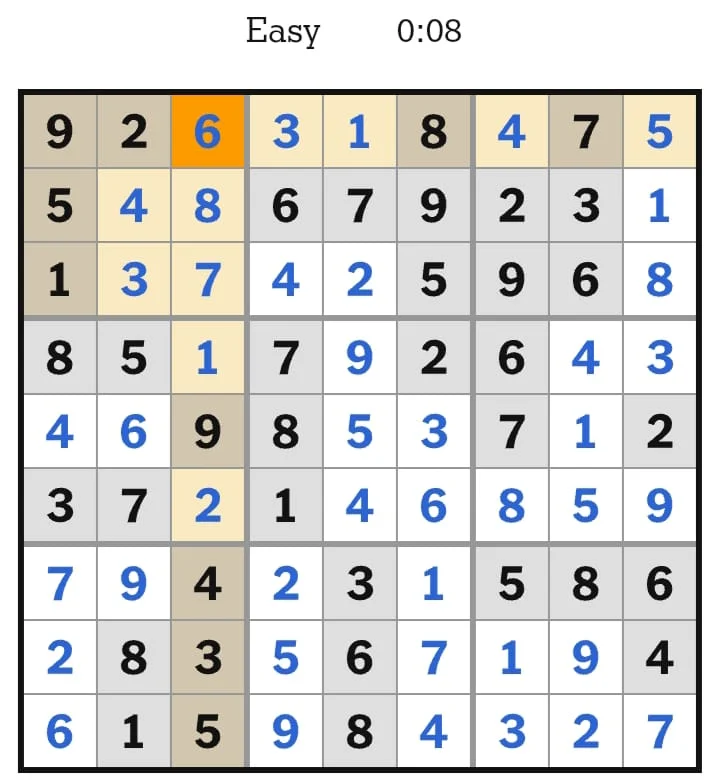
We are confident that you can solve the easy Sudoku NYT puzzle with ease. But if you are stuck and need guidance, then the screenshot of the solution is given. Check it out to get familiar with the patterns and number placements, and then move forward to the medium sudoku.
NYT Sudoku Medium August 23, 2026
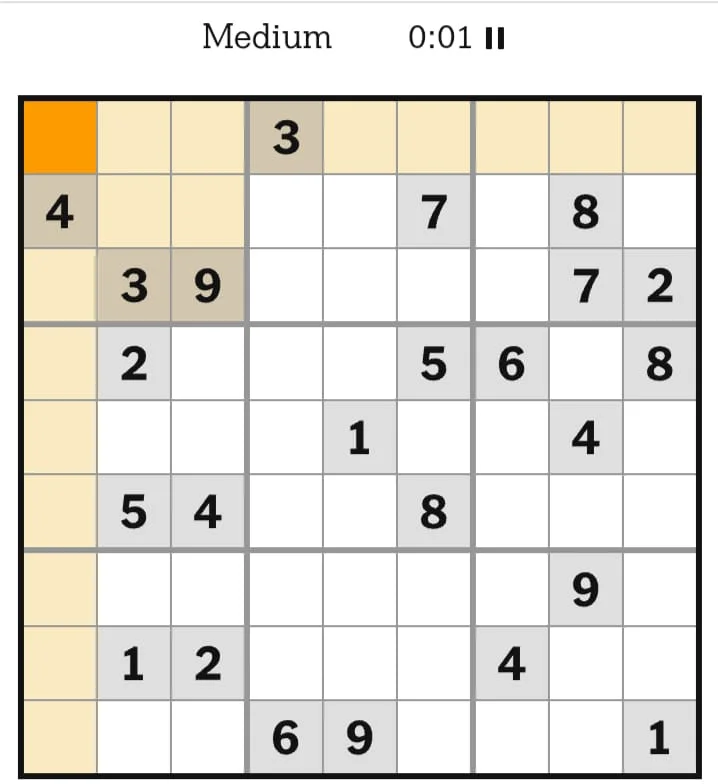
The Sudoku medium nytimes puzzle is a bit more difficult than the easy one and requires logical deduction and estimation of numbers in each cell. Using your skills, try to solve it on your own. But for help, feel free to check the NYT sudoku medium answers today.
NYT Sudoku Medium Answers August 23, 2026
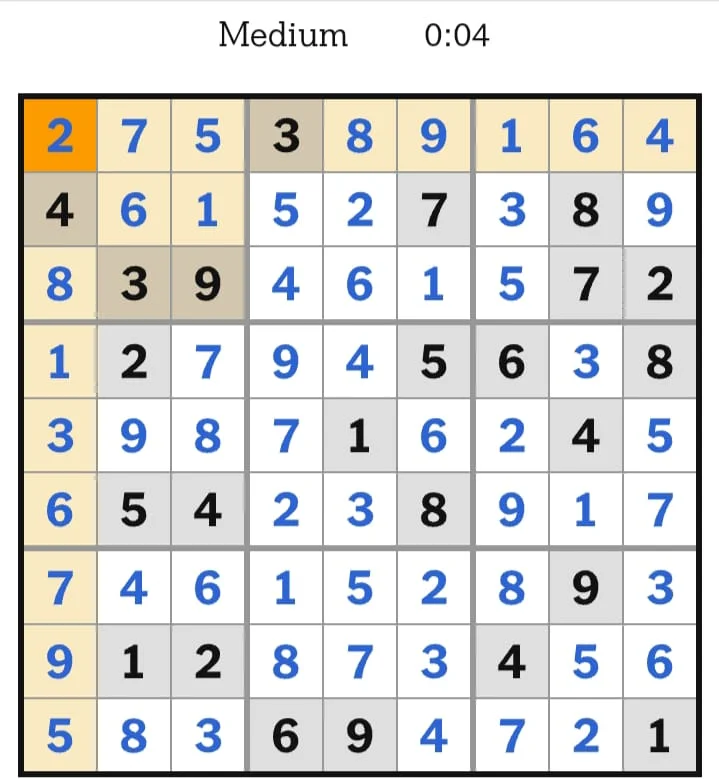
With practice and consistency, you can solve any puzzle without any help and that moment will be rewarding. But to keep yourself on track, get help and suggestions from Sudoku Medium NYT answers screenshots. Get yourself warmed up for the New York Times Sudoku hard puzzle.
NYT Sudoku Hard August 23, 2026
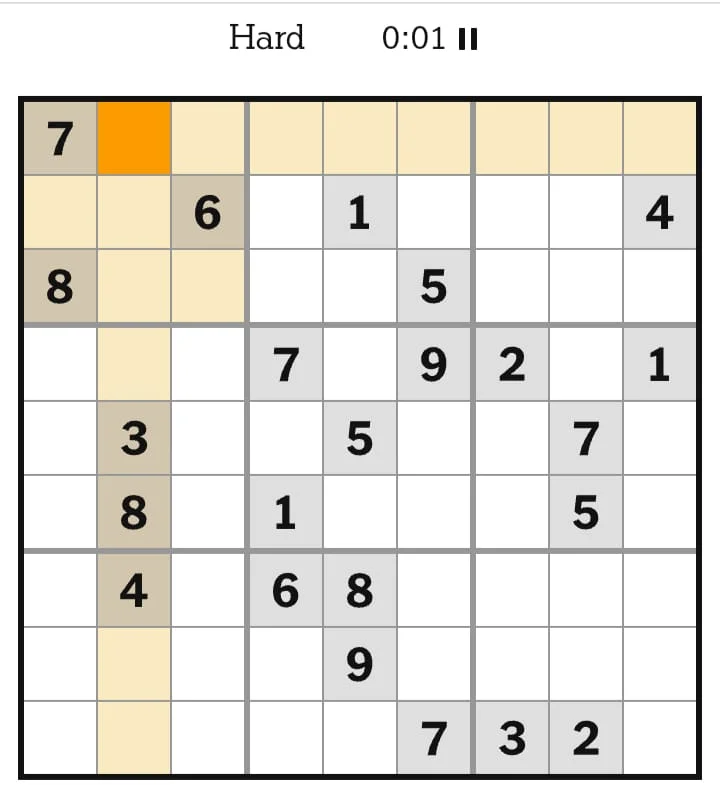
Times Sudoku’s hard level requires skills and patience. With logical thinking and correct placement of numbers, this level can be solved. The winning moment will be worth practicing. Solve it and become a professional at Sudoku.
NYT Sudoku Hard Answers August 23, 2026
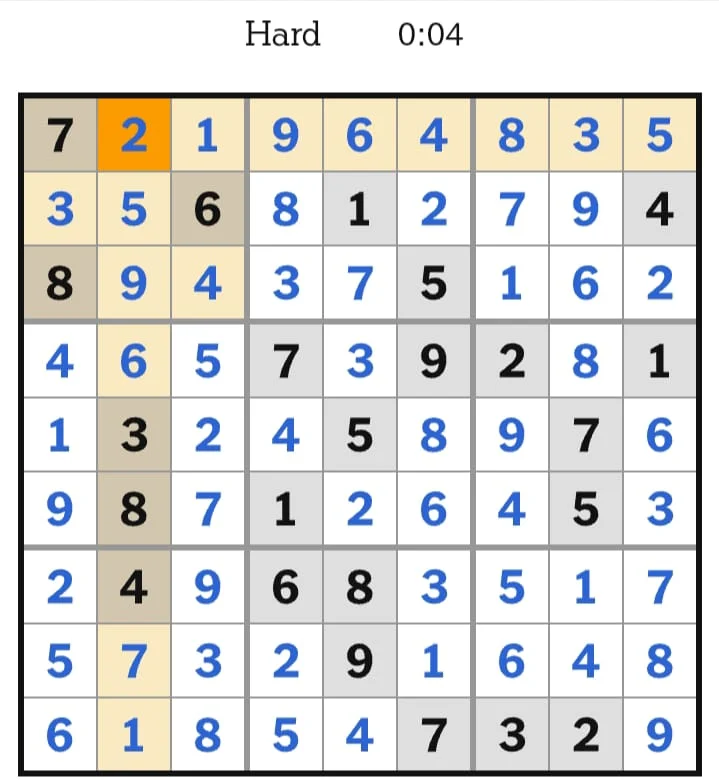
The NYT Sudoku hard answers today are provided here to help you in case you need suggestions at any point. Try again and again till you solve it yourself.
Latest Posts
| M | T | W | T | F | S | S |
|---|---|---|---|---|---|---|
| 1 | 2 | 3 | 4 | |||
| 5 | 6 | 7 | 8 | 9 | 10 | 11 |
| 12 | 13 | 14 | 15 | 16 | 17 | 18 |
| 19 | 20 | 21 | 22 | 23 | 24 | 25 |
| 26 | 27 | 28 | 29 | 30 | 31 | |
Get Professional Tips To Solve NYT Sudoku Daily
The New York Times Sudoku features different levels from easy and medium to hard, so players can choose difficulty based on their preferences. By offering new and fresh grids every day, this game keeps the player focused and active-minded during the solving process.
Those who have recently started playing this game need to stay consistent to get familiar with the grid and strategies. However, we are here to help you solve the hard puzzles with ease by providing all the professional strategies and tips. Play today’s NYT Sudoku on our website with upgraded skills. Best of Luck!
Features of the New York Times Sudoku
Check out the best features of Sudoku New York Times that make this game an unforgettable experience for players.
Free Daily Puzzles
This game features new puzzles every day, ranging from mini to hard levels. New challenges are waiting for you here.
Multiple Gameplay Modes
While solving the puzzle, players can access Candidate mode or Normal mode. With candidate mode, you can make potential choices for each empty cell and get multiple possibilities before making a decision. In normal mode, players make confident moves based on their skills. If you are a beginner, you must enable Auto Candidate mode to tackle Medium and Hard puzzles with several hints.
Error Counter
While playing, if the player makes any mistake, it displays a red dot at the bottom of the square. It tracks how many mistakes you make, providing a good way to challenge yourself.
Cell Highlighting
Your selected row, box, and column will be automatically highlighted, or all identical numbers will be highlighted, depending on your preference.
Dark Mode
Players get dark mode to play the game at night with low light, which is best for their eyesight. It’s available in the NYT Games app or the NYT News app’s dark theme.
Additional Tools
Sudoku Nyt features many tools to solve puzzles with fun. These perks are:
- The timer tells the players how long it will take to finish the New York Times Sudoku Hard.
- With the Undo button, you can go back and fix your previous move.
- With the pencil feature, also known as candidate mode, you can get multiple possibilities for a single cell before making a move.
- With the check button, players can check their wrong answers and try again to play better.
Hints and Auto-Check
In-game, there are hard levels that can be difficult for us sometimes. To make it less complicated, players can use the NYT Sudoku hint and auto-check option offered by the NYT Sudoku hard. You just need to press “Hint” to get a clue for the next cell.
Pause Option
To keep players stress free, this game comes with a pause option, so players can take a break at any time and jump back into the game whenever they’re ready.
Archive Access
Old puzzles are available to replay. Our website offers NYTimes sudoku archives and lets you revisit past challenges whenever you want. You don’t need any subscription for this.
Custom Settings
There are many customization options for players to play the game as they like. They can enable automatic checking for your guesses, highlight conflicts, and enable the sound options for when you solve a puzzle.
Wide Device Compatibility
The sudoku nyt today app is compatible with various devices, including desktops, Androids, iPhones, and all types of devices with internet. You can play it anytime and anywhere.
Option To Print
This game offers a Sudoku printable, so you can get the puzzle on paper and solve it with ease. Print in PDF format with the free Acrobat Reader.
Where and When You Can Play New York Times Sudoku
Platforms to Play
You can play New York Times Sudoku on:
From our website NYT Sudoku:
The best platform designed to enjoy daily sudoku nyt Puzzles without any subscription. Moreover, get the Sudoku Archives to play old puzzles.
Other sources:
The NYT Games website and The New York Times mobile app
Timing / Puzzle Release
Sudoku puzzles are updated on a specific schedule:
From Tuesday to Saturday
A fresh puzzle is released at 10 p.m. Eastern Time.
On Sunday and Monday
The new puzzle is released at 6 p.m. Eastern Time.
If you’re a regular player, you can look forward to new Sudoku New York Times easy, medium, & hard challenges every day from our website.
Sudoku NYT Gameplay Settings
You can access the Gameplay Settings from the main puzzle page.

What are the basic rules of Sudoku?

How to Solve NYT Sudoku Easily? A Walkthrough
If you are a beginner and want to solve the puzzle with ease, then check out our new york times sudoku solving guide given below.
Open the Puzzle
First of all, open our website to solve the daily new puzzle. You can choose the difficulty levels, whether easy, medium, or hard.
Initial Scan
Start the game and scan each row, column, and 3×3 box, and see which numbers are already filled in. With this quick scan, you can find out which number is missing and where only one number logically fits.
Enable Notes Mode
Switch from normal mode to candidate mode to check out the potential possibilities for a cell. There might be a 3×3 region that has 3 or 4 open cells. You can note possible numbers.
Fill Confident Spots
With possible notes in place, you see that number 7 can only be placed in a particular cell because all the other numbers are eliminated by row, column, or box. You will place 7.
Use Logical Patterns
If you notice a pair of cells in a column or row that contain only {4, 8} as a candidate number, it means those two are those numbers. So no other cell in that column or row can be 4 or 8.
Error Check
If error checking is on, one wrong move will show a red dot. You can undo that number, or go back to your candidate notes and correct it.
Progress + Cascading Solves
As you move forward and fill more cells, some of the previous notes cancel out or simplify. You can find new possibilities, fill more cells, and continue until the whole grid is filled.
Final Moves
At the end, with the final empty square, you can make a “what-if” assumption to see if the candidate leads to a valid solution. If it fails, you can go back and try again.
Completion
Once the whole grid is filled with all possible numbers, you check that each row, column, and 3×3 small grid has numbers from 1-9. There must be no repetition. It means you have solved the puzzle and can check how long it took.
Reflect
You can note which strategies helped you a lot and which were less helpful. So next time, you can use other techniques, such as X-wing, Y-wing, or others, and be more aggressive with notes.
Want to take your Sudoku solves to the next level?
Once you’re skilled with the NYT Sudoku easy and NY Times Sudoku medium puzzles, you can follow these advanced strategies. These professional tricks will be helpful for the hard ones.
“Last free cell” technique
According to this technique, each 3×3 block, column, and row on the Sudoku grid should contain numbers from 1 to 9, and each number can be used only once. Check the row, column, and box to see the missing number for one free cell.
“Last remaining cell” technique
According to this technique, the numbers can’t be repeated in a row, column, or 3×3 block. For example, if there is a number 8 in the row and column, then we cannot enter it there again because it’s already present. It means in the last remaining cell in the block, we have to enter the number 8.
“Last possible number” technique
In this technique, we have to find the last missing number. Scan the numbers that are already present in the interested block, and the row and column that correspond to it, to find the missing number.
Notes in Sudoku
If you are finding it hard to solve the puzzle and are stuck on a single grid, you can use the Sudoku notes. With this, you can find possible options for each cell. But keep in mind to fill the notes correctly, because in case of any mistake, solving the puzzle will become more difficult.
“Obvious singles” technique
This technique is also known as naked singles. If only one digit from the notes is available in a single cell, that will be the possible option. For example, if the cell is filled with only one note, that is number 4. Then the number 4 will be the only possible solution for that cell.
“Obvious pairs” technique
If you find 2 cells with the same pairs of Notes within a block, it means we can’t use these notes in other cells of that block. For example, a grid is filled with notes with possible numbers. In these cells, there are two cells with 8 and 5 numbers within the block. It means one of these cells will contain either 8 or 5, and we cannot add these numbers in other cells of that block.
“Obvious triples” technique
This technique is like the obvious pair technique, but the only difference is that it is based on three numbers from the notes. For example, three cells of the block have notes of 1,3, 1,5 & 3, 5. In these cells, 1, 5 & 8 numbers are present, but we don’t know their exact position. All we know is that these numbers can’t be used in other cells of this block.
“Hidden singles” technique
It indicates that there will be only one kind of note in an entire row, column, or 3×3 block. It becomes difficult for the player to spot these single notes. Consider an example to understand this. There is a 3×3 block with Notes, and it has only one cell that has a number 1. There will be no other cells in the block with Note 1.
“Hidden pairs” technique
This technique is the same as hidden singles, but the only difference is the number of cells and Notes. If there are two cells within the row, column, or 3×3 block, having two Notes nowhere outside these cells. These notes will be entered in the two cells, while others will be eliminated.
“Hidden triples” technique
This has the same concept as hidden pairs, but it applies when there are the same three Notes in three cells in a row, column, or 3×3 block. These Notes will occupy these cells while other candidates will be eliminated.
“Pointing pairs” technique
This technique applies when there is a Note present twice in a block, and the same note is also part of the corresponding row and column. This indicates that this Note will be the solution of one of two cells, while this Note in any other cells in the row and column will be eliminated.
“Х-wing” technique
This technique does not involve the 3×3 blocks concept; it is based on two parallel rows or two parallel columns. Take an example of two rows in which two cells in each row have a Note of 4. As the number can’t be repeated in the same row and column, it means the 4s will be entered diagonally.
Play New York Times Sudoku Now!
Pick a date from the calendar and challenge yourself with daily ny times sudoku puzzles. To solve today’s Sudoku puzzle, you can choose the current date or even get the chance to solve puzzles from previous days or months from our available New York Times Sudoku archive.
FAQs
Conclusion
The NYT Sudoku is the best game introduced by The New York Times. With its new and fresh grids in every puzzle, it becomes the most played game. It features easy, medium, and hard levels. Solving the easy challenges takes a few minutes, but the hard ones can be difficult for a player like us.
To make you a skilled and Pro player, our website provides professional techniques, tips, and Sudoku NYT answers, medium, hard, and easy. You can check out the available NYT Sudoku Archives or play the NY Times Sudoku Today Free.